
Agnes Gund H’12 died on September 19, 2025, in New York, New York.
(The following was provided by New York Times in September 19, 2025:)
Agnes Gund, Who Oversaw a Major Expansion of MoMA, Dies at 87
A champion of contemporary art, she was the museum’s president for 11 years. She also founded the Art for Justice Fund, donating $100 million.
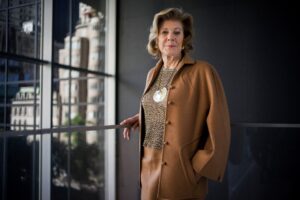
Agnes Gund in 2014. Her long relationship with the Museum of Modern Art began in 1967, when she joined the museum’s international council. She steadily ascended the administrative ranks and eventually became president in 1991. Credit…Damon Winter/The New York Times
By William Grimes
Agnes Gund, an art collector and philanthropist who served as president of the Museum of Modern Art as it embarked on a major expansion in the 1990s and championed the cause of contemporary art within its walls, died on Thursday night at her home in Manhattan. She was 87.
Her daughter Catherine Gund confirmed the death.
Ms. Gund was an avid collector of contemporary art. She surrounded herself with works by Mark Rothko, James Rosenquist, Jasper Johns, Brice Marden, and a host of others, many of whom became her friends.
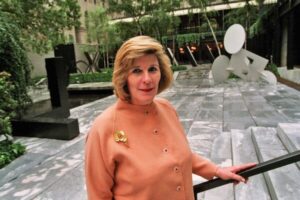
Ms. Gund in the Museum of Modern Art’s sculpture garden in 1995. Credit…Sara Krulwich/The New York Times
Later in life she turned her attention to the work of nonwhite artists and artists from other countries. Sales from her collection helped finance her myriad commitments to social programs, most notably in 2017, when she privately sold Roy Lichtenstein’s “Masterpiece” (1962). The sale realized $165 million, of which she used $100 million as seed money for the Art for Justice Fund, a time-limited initiative that provided grants to promote criminal justice reform. It ceased operations in 2023.
Ms. Gund wanted to collect and donate more than her resources would allow, acknowledging in a 2014 interview with The New York Times that she tended to give away “more money than I really have.”
“I’ve had to sell a lot of art,” she said, “which I’ve hated to do because I really love the art I have.”
Her long relationship with the Museum of Modern Art began in 1967, when she joined the museum’s international council. She steadily ascended the administrative ranks and eventually became president in 1991, an unpaid position that she held for 11 years. In that period she oversaw the museum’s ambitious $858 million expansion, which involved the construction of a new building by Yoshio Taniguchi. Completed in 2004, it doubled the museum’s exhibition space.
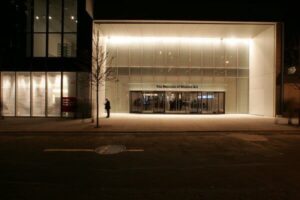
Ms. Gund oversaw the museum’s $858 million expansion, which involved the construction of a new building designed by Yoshio Taniguchi, completed in 2004. Credit…Fred R. Conrad/The New York Times
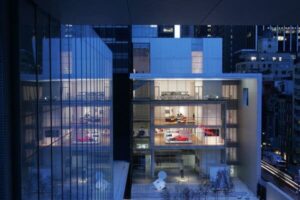
A night view of the museum’s main gallery addition, across from the sculpture garden.
Credit…Fred R. Conrad/The New York Times
Ms. Gund also lobbied energetically for contemporary art, which the museum had neglected over the years. She created a special fund to support exhibitions by contemporary artists who would not normally attract corporate funding, and she played a pivotal role in the 1999 agreement to merge the museum with the P.S. 1 Center for Contemporary Art in Long Island City, Queens (Now MoMA PS1). Over her lifetime, she donated more than 1,000 works to the museum, her family said.
“She was a strong advocate for contemporary art for twenty years and more,” said Robert Storr, a curator of painting and sculpture at the museum during Ms. Gund’s presidency. “She wanted the museum to become fully engaged with contemporary art at a time when Bill Rubin was nearly the opposite, and Richard Oldenburg was wary.” (William S. Rubin was the director of the department of painting and sculpture from 1973 to 1988, and Richard E. Oldenburg was the museum’s director from 1972 to 1995.)
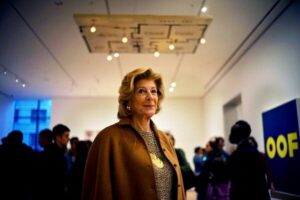
Ms. Gund at the museum in 2014. “She’s always working,” Klaus Biesenbach, a former director of MoMA PS 1, said that year. Credit…Damon Winter/The New York Times
Even into her later years, Ms. Gund was known for always showing up — at museum galas, gallery openings and artists’ often far-flung studios.
“She’s always working,” Klaus Biesenbach, a former director of MoMA PS 1, told The Times in 2014. “She makes her philanthropy a 24/7 full-time job and therefore makes herself an institution.”
She became close to some of contemporary art’s brightest stars, both established and emerging. Among her more prominent artist friends were Ellsworth Kelly, Roy Lichtenstein, Jasper Johns and Frank Stella. And she was known for championing female and Black artists.
Glenn D. Lowry, who stepped down this month as the director of the museum, told W magazine in 2009 that Ms. Gund “believes in artists; she’s willing to take risks.” He added, “I think there’s no question her legacy is already defined by her deep and passionate commitment to living artists.”
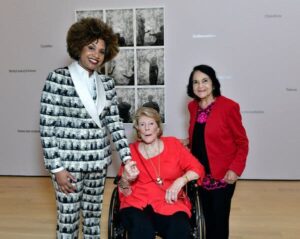
From left, the artist LaToya Ruby Frazier, Ms. Gund and the labor leader Dolores Huerta at the opening of the exhibition “LaToya Ruby Frazier: Monuments of Solidarity” at MoMA in 2024.nCredit…Eugene Gologursky/Getty Images for Museum of Modern Art
Agnes Gund, known as Aggie, was born on August 13, 1938, in Cleveland. Her father, George Gund II, built an immense fortune in real estate, brewing, and investing, and for many years served as president of the Cleveland Trust Company, Ohio’s largest bank at the time. Her mother, Jessica Roesler Gund, oversaw the home.
Agnes’s interest in art was sparked by classes at the Cleveland Museum when she was a child and deepened during her time at Miss Porter’s School in Farmington, CT, where she was sent after her mother’s death in 1954. “I had a magical art history teacher who didn’t just give you the artist’s name and the date of the picture; she showed you how to look at artwork,” she told Lifestyles magazine in 2010.
In 1963, three years after graduating from Connecticut College for Women (now Connecticut College) with a history degree, she married Albrecht Saalfield, known as Brec, a private-school teacher and an heir to the Saalfield Publishing Company, a leading producer of children’s books and educational products. The marriage ended in divorce, as did a second marriage, to Daniel Shapiro, a lawyer and teacher.
In addition to her daughter Catherine, from her first marriage, she is survived by three other children from that marriage, David Saalisi, Jessica Saalfield, and Anna Traggio; her brothers Gordon and Geoffrey Gund; a sister, the theater producer Louise Gund; and twelve grandchildren. Her brother Graham Gund, a noted architect, died in June at 84. Her brother George Gund III, who bought and sold a number of professional sports teams, died in 2013 at 75.
Ms. Gund’s father died in 1966, leaving her a large fortune in the form of a trust. Soon after that, she bought a work by the English sculptor Henry Moore. Over the years, she added works by Joseph Cornell, Willem de Kooning, Ellsworth Kelly, Eva Hesse and Lynda Benglis and, more recently, Kara Walker and Lorna Simpson.
Nearly all her collection was promised to museums, and during her lifetime she donated lavishly to the Cleveland Museum of Art, the Museum of Modern Art, and the Philadelphia Museum of Art.
“It could be because I feel guilty about having so much more than most people,” she told Crain’s New York Business in 2006. “If I can have it, others should be able to enjoy it.’‘
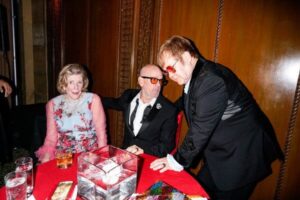
Ms. Gund with Michael Stipe of R.E.M., center, and Elton John at a benefit for the Elton John AIDS Foundation in New York City in 2018. Even into her later years, Ms. Gund was known for always showing up — at museum galas, gallery openings and artists’ often far-flung studios. Credit…Rebecca Smeyne for The New York Times
In 1977, after the City of New York drastically cut the budget for art education in the public schools during a financial crisis, Ms. Gund used her own money to found Studio in a School, a nonprofit organization that brings artists into schools to work with students and teachers. “The first year we started with three schools — two in the Bronx, one in Manhattan,” she told Gagosian Quarterly in 2014, “And then we had five the next year.” The organization now serves numerous schools in all five boroughs.
“Studio in a School has benefited low-income students for nearly five decades,” former Mayor Michael R. Bloomberg of New York said in a statement, in which he lauded Ms. Gund’s “deep devotion to work involving social justice, health and the environment” as well.
Ms. Gund, who returned to school in middle age to earn a master’s degree in art history from Harvard in 1980, served on the boards of several museums and nonprofit organizations, including the Cleveland Museum of Art, the Morgan Library & Museum and the Frick Collection.
From 1993 to 1995 she held the dual posts of president and chairman of the Museum of Modern Art, to which she donated more than 250 artworks during her lifetime. In 2018, the museum honored her legacy with a special exhibition, “Studio Visit: Selected Gifts From Agnes Gund.”
In her later years, Ms. Gund directed much of her philanthropy to social-justice causes. She served on the boards of the Socrates Sculpture Park in Long Island City and the Robert Rauschenberg Foundation, where she served on the philanthropy committee. In 1997, she received the National Medal of Arts from President Bill Clinton.
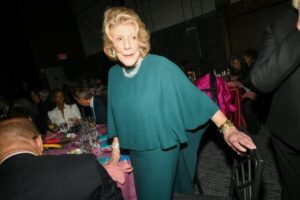
Ms. Gund in 2022 at a gala for Studio in a School, a nonprofit organization, established with her own money, that brings artists into schools to work with students and teachers. Credit…Dolly Faibyshev for The New York Times
She also served in the public sector as a member of the New York State Council on the Arts and as a chairwoman of the Cultural Affairs Advisory Commission of New York City.
In 2007, Ms. Gund and Elizabeth W. Easton founded the Center for Curatorial Leadership, an organization that has become the leading institute for training curators and defining their role in museums.
In 2023, in response to the Supreme Court decision overturning Roe v. Wade, Ms. Gund sold another Lichtenstein painting, “Mirror #5” (1970), for $3.8 million, which she donated to twenty-nine organizations that advocate for reproductive rights, her family said.
“I felt compelled to part with this beloved work by an artist who means so much to me because I believe in the power of art as a tool for advocacy and inspiration,” Ms. Gund told Christie’s, which auctioned the work. At that point, with the rest of her collection spoken for, the cupboard was bare. As she told W magazine, “I’m afraid that’s about it.”
Robin Pogrebin contributed reporting.
A correction was made on
Sept. 19, 2025
An earlier version of this obituary referred incorrectly to Ms. Gund’s sale of Roy Lichtenstein’s “Masterpiece.” It was sold privately, not at auction.
A correction was made on
Sept. 22, 2025
An earlier version of this obituary misstated Glenn D. Lowry’s association with the Museum of Modern Art. He stepped down as director this month, shortly before Ms. Gund died; he is not the current director. The obituary also referred incorrectly to Ms Gund’s sale of a Roy Lichtenstein painting, “Mirror #5.” It sold for $3.8 million, her family said, not $3.1 million, and Ms. Gund donated the proceeds to 29 organizations that advocate for reproductive rights, not one such group.